Loading.
Become an agentic engineer.
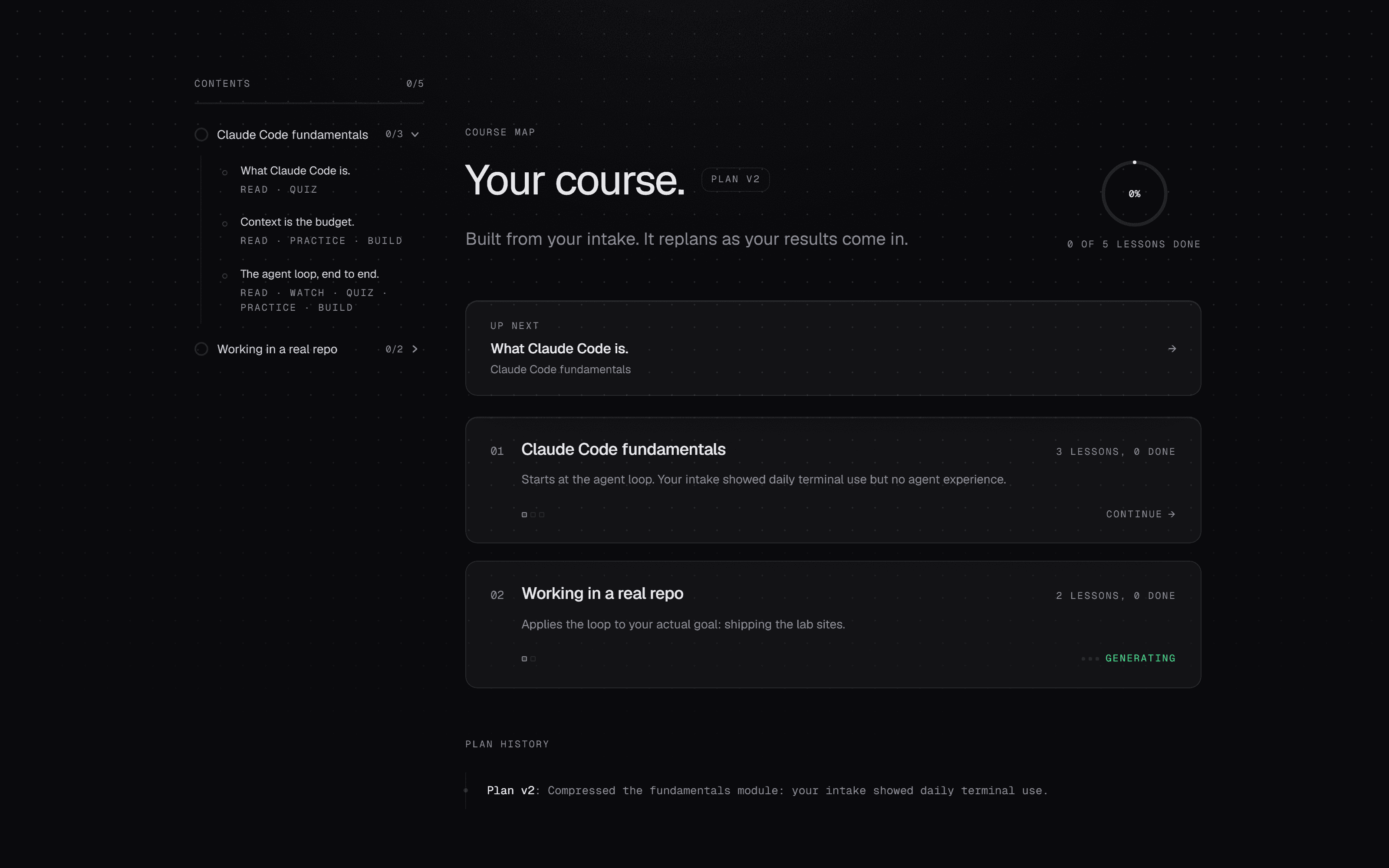
You will not write most of the code. You will decide what gets built, direct the agent that writes it, and answer for what ships. That is a skill, and this is where you learn it.
“engineering” to emphasize that there is an art & science and expertise to it. It's something you can learn and become better at, with its own depth of a different kind.
Introducing Agentic Engineers
The floor has come up. The bar has not moved. Anyone can get working code out of a model now. What nobody can do for you is decide what to build, notice when the agent is confidently wrong, and take responsibility for the thing that ships. That work did not go away. It became most of the job.
So this teaches the job, not the tool. An agent asks you what you have built, writes you the course you need, and teaches from sources you can open and check. Then it grades what you build. You get the leverage. You do not get to skip the judgment.
Grounded by construction
Learn it from the people who built it.
Your lessons are written from the Claude Code and Agent SDK documentation and from Anthropic talks, cited to the timestamp. You are reading the primary material, arranged for you.
Citations open on the passage they came from, in the docs or the video at its timestamp.
The plan rewrites itself on your results. Pass early and it compresses. Struggle and it slows down.
Every lesson keeps its trace: what it retrieved, what wrote it, what the verifier checked, what it cost.
You skip what you already know.
It asks what you have built, what you want to build, and how many hours a week you really have. If you already know git, you will not sit through git. If you have never deployed anything, you will deploy something this week.
Start the interviewIt opens what you built.
Build tasks end with a URL. Deploy the page, paste the link, and it reads your page against the brief and tells you what passed and what did not. Checkpoints are marked the same way. Nothing here is graded on attendance.
Nothing is pre-recorded. It writes the lesson when you open it.
It pulls the sources for what you are about to learn, writes the lesson for where you actually are, and cites the passage behind every claim.
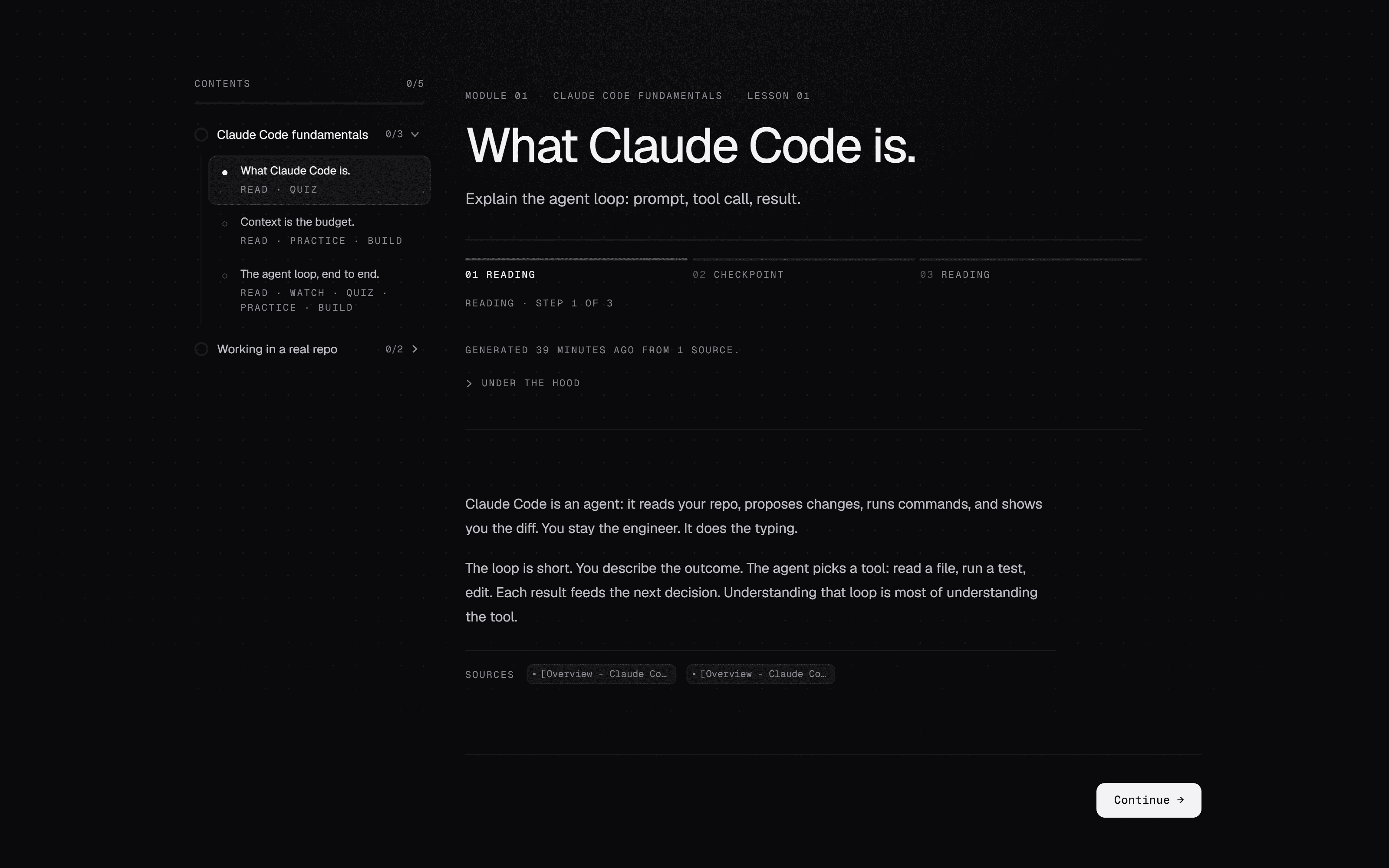
Under the hood
The oversight is the lesson.
A second agent reads every claim against the passage it cites, before the lesson reaches you. It has already stopped one that stated something the documentation never said.
That is the same check you will be doing on your own agents by the end of this. So the platform runs it in the open: what was retrieved, which model wrote it, what the verifier found, what it cost.
trace · authorlesson: What Claude Code is.
Retrieve2 chunks · the lesson may only teach from these
Authorclaude-opus-4-8 · 6,412 in · 1,287 out · $0.04
Verifycitations, links, answer keys · verdict pass
Publishlesson ready · every edit repeats this pipeline